Toxic Is Not a Diagnosis: How the Business World Replaced Rigorous Diagnosis with an Emotional Label
- Paul T. Ayres
- Newsletter
EXECUTIVE SUMMARY
Over the last several years, with unmistakable acceleration since 2020, the business world has developed a strange and consequential habit. Faced with increasingly complex organizational challenges, leaders, consultants, coaches, influencers, and employees alike have begun reaching for a single word to explain nearly everything that goes wrong at work.
Toxic.
The word appears so frequently that it has become difficult to discuss organizations without encountering it. Toxic leaders. Toxic managers. Toxic coworkers. Toxic teams. Toxic cultures. Toxic organizations. Oxford Languages named it Word of the Year for 2018, documenting a 45% surge in usage in that single year alone. Since then, it has only proliferated further, becoming the dominant vocabulary of organizational complaint.
The problem is not that destructive workplace behavior does not exist. It clearly does. Harassment exists. Bullying exists. Retaliation exists. Workplace aggression exists. Unethical behavior is real, and its consequences are serious. Every serious researcher in organizational behavior would agree with those statements without reservation.
The problem is that the word "toxic" has become detached from diagnosis and attached to emotion.
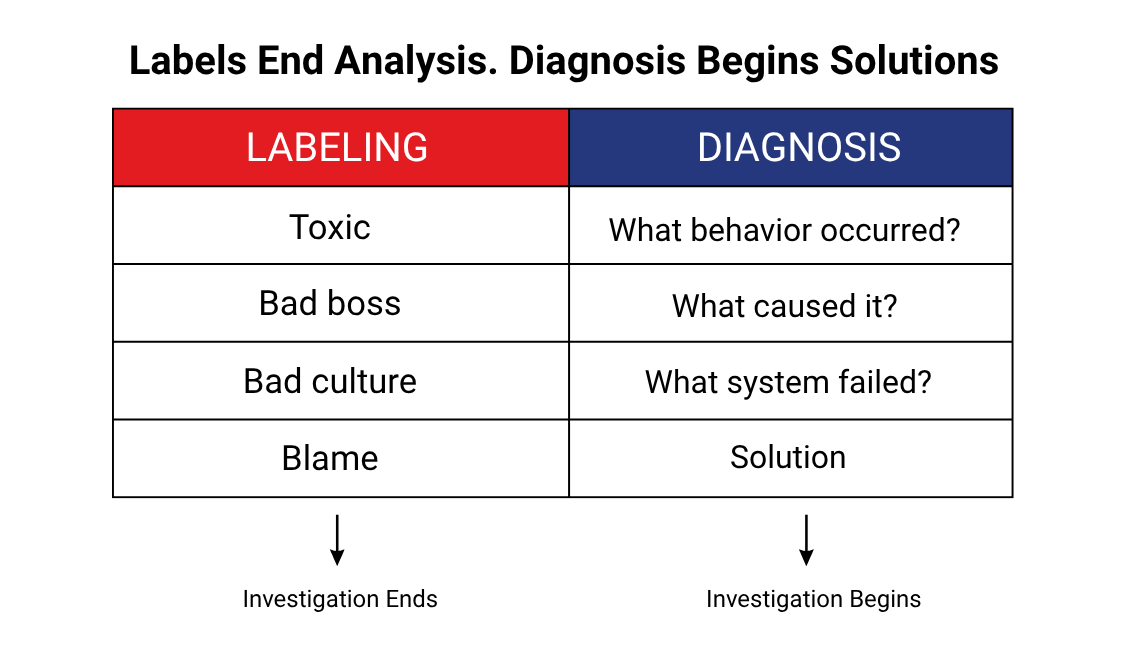
In practice, it is increasingly used not as a professional description of specific behavior but as an emotional conclusion reached before meaningful analysis begins. Once the label is applied, investigation often stops. The individual becomes the problem. The leader becomes the problem. The entire accountability structure shifts to a single explanation, while the organizational systems, communication failures, skill gaps, structural misalignments, and, critically, employee-side behaviors that almost always contribute to dysfunction remain entirely unexamined.
This article argues, with evidence from MIT Sloan Management Review, McKinsey, the Harvard Business Review, the American Psychological Association, Gallup, SHRM, and the peer-reviewed organizational behavior literature, that organizations would benefit significantly from retiring the word "toxic" from most professional discussions, not because serious workplace problems do not exist, but because solving those problems requires something far more demanding than labeling. It requires diagnosis. And diagnosis begins with understanding causes, not assigning villains.
I. The Vocabulary Problem Nobody Is Naming
Let me be direct with you. I am tired of the word "toxic."
I am tired of seeing it in every other LinkedIn post describing a manager who gave someone direct critical feedback. I am tired of coaches, many of whom have never managed a budget, a production floor, or a team of twenty through a genuinely hard quarter, using it as the centerpiece of their marketing pitch. I am tired of employees who have legitimately complex interpersonal situations with colleagues or supervisors reaching for that word as their first and final diagnosis, because someone in a podcast told them it was exactly what they were experiencing. And I am genuinely tired of watching organizations invest significant time, money, and goodwill chasing a phantom while the actual roots of the dysfunction they are living with go unaddressed and continue to compound.
The irony is not subtle. The coaching and human resources community spent the better part of a decade insisting that organizations need to build the capacity for honest, courageous, productive conversations. Then it handed everyone a word so emotionally charged, so morally pre-loaded, and so legally adjacent that it stops honest conversation rather than starting it. Once someone calls a leader, a colleague, or a culture "toxic," the conversation is effectively over. The label has been applied. The verdict is delivered. There is no longer a problem to solve. There is only a poison to identify and escape.
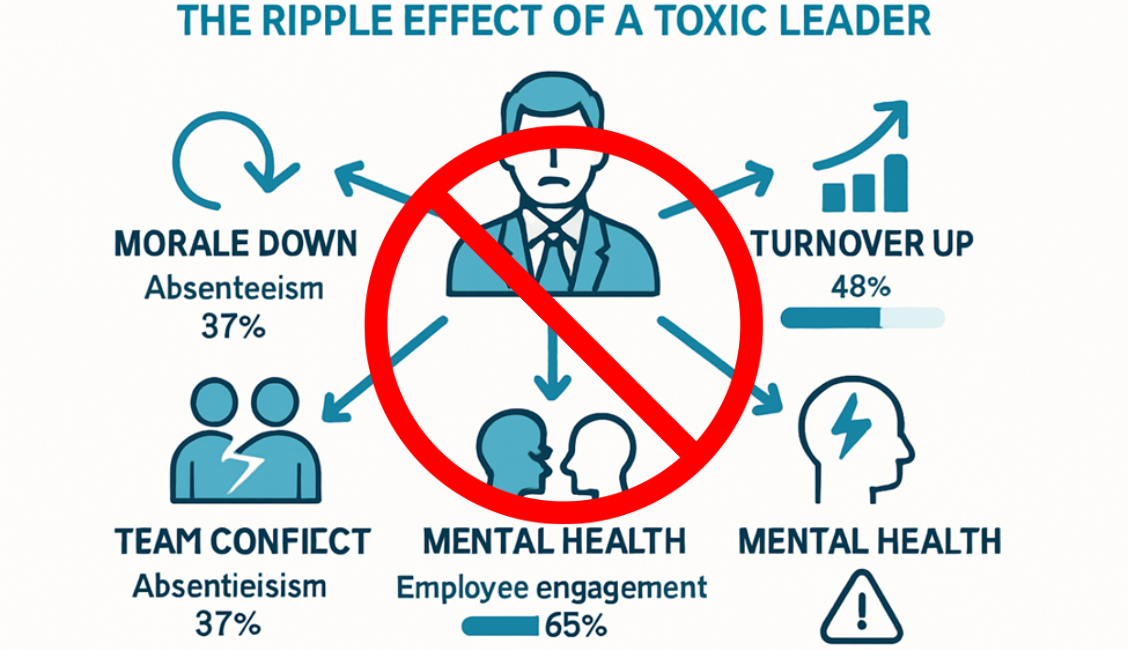
All of these statistics are actually in question. This chart and accompanying studies, when asked questions that include the word ‘toxic,’ can elicit biased responses. Therefore, charts like these may actually not validate what they imply. A huge missing line is just what the dysfunction in question is. Also, does the dysfunction cause real harm to someone, or is the use of the word toxic as a metaphor just exaggerating a situation someone didn’t like? There is a huge difference between annoyance and actual harm. Another interesting interpretation is that these numbers, at best, break down 19% of employees (those who identified their workplace as toxic, so for example, the issue is .19% x 37% = 7% of people experience moral issues due to what they interpret and label as toxic. We don’t, in fact, know if the issue a metaphor or in fact harmfully dysfunctional. And this is more so a pole of emotions vs. identification of root cause.
That is not professional practice. That is not rigorous coaching. And the research, from some of the most credible institutions in management and organizational science, supports exactly what I am observing in my own small business and in the organizations I work alongside every single day.
The Word That Took Over
Oxford Languages, the authority behind the Oxford English Dictionary, named "toxic" its Word of the Year for 2018, citing a 45% rise in the frequency with which users searched the word in that single year. The breadth of contexts in which people were searching was striking: toxic relationships, toxic masculinity, toxic culture, toxic leadership, toxic coworkers, toxic schools, toxic stress. Oxford's researchers noted that the word had "truly taken off into the realm of metaphor, as people have reached for the word to describe workplaces, schools, cultures, relationships and stress."
That was 2018. In the years since, the word did not recede. It accelerated. What began as emotionally charged responses to highly publicized coverage of the #MeToo movement and cases of organizational abuse gradually became something far broader and far less precise. The term migrated from describing specific, legally definable patterns of harassment, discrimination, and systematic abuse to describing virtually any interpersonal situation that someone found uncomfortable, disappointing, frustrating, or simply difficult.
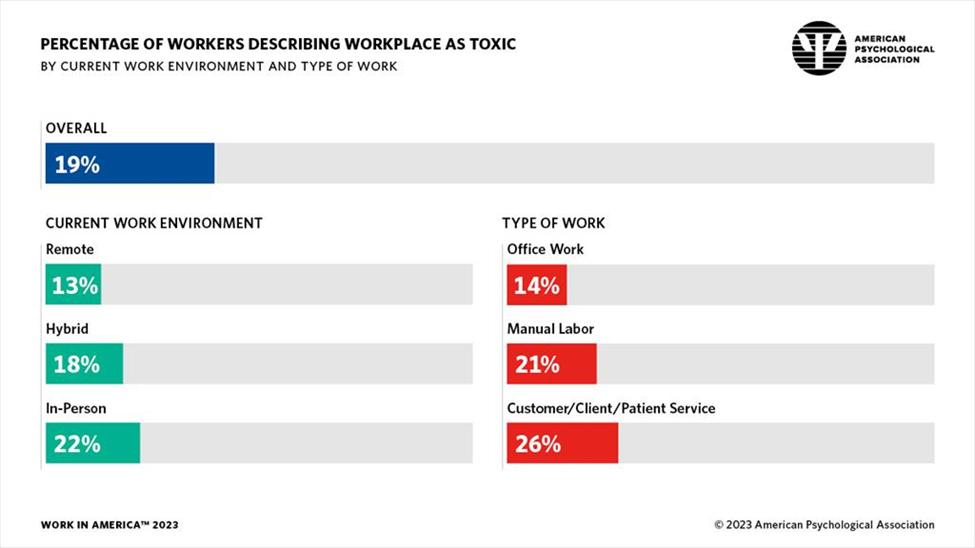
Source: American Psychological Association, Work in America™ Survey 2023.
By 2023, the American Psychological Association's Work in America survey found that 19% of workers described their workplace as "toxic." That number is cited constantly and enthusiastically by coaches, consultants, and organizational commentators, because it fuels a market. What those same voices cite far less often is what that 19% was actually experiencing, what specific behaviors they were describing, and whether any of it met a consistent clinical, legal, or operational standard for what the word was originally designed to convey. Of course, it needs to be pointed out that 81% of workplaces, therefore, are not toxic according to the same study. The focus on the issue that was not mainstream has run amuck.
One thing the research does confirm is that the language of toxicity has spread far beyond the academic community that first deployed it. A search of LinkedIn content over any given week will reveal post after post attributing organizational problems to toxic leaders, toxic managers, and toxic cultures. Employees appear almost exclusively as affected parties. Leaders appear almost exclusively as perpetrators. The flow of dysfunction, in this telling, is entirely top-down and essentially one-directional. This framing is not supported by the organizational research literature, as we will explore shortly. But it is relentlessly amplified, because it engages audiences, and engagement is the currency of the platforms on which it travels. And those pushing the term are trying to ‘sell.’
II. The Rise of ‘Toxicity Industry’
As someone who has spent over four decades leading organizations, advising executives, building businesses from the ground up, and working through difficult operational problems in industries from civil construction to logistics to mining to manufacturing, I have become increasingly skeptical of what I have come to call the Toxicity Industry.
The Toxicity Industry is not a formal organization. It is a collection of consultants, coaches, influencers, authors, speakers, and social media personalities who have discovered, and not without entrepreneurial creativity it must be said, that blaming workplace problems on toxic people is far easier, and far more marketable, than helping organizations understand the actual causes of dysfunction.
The formula is remarkably effective, and once you see it you cannot unsee it.
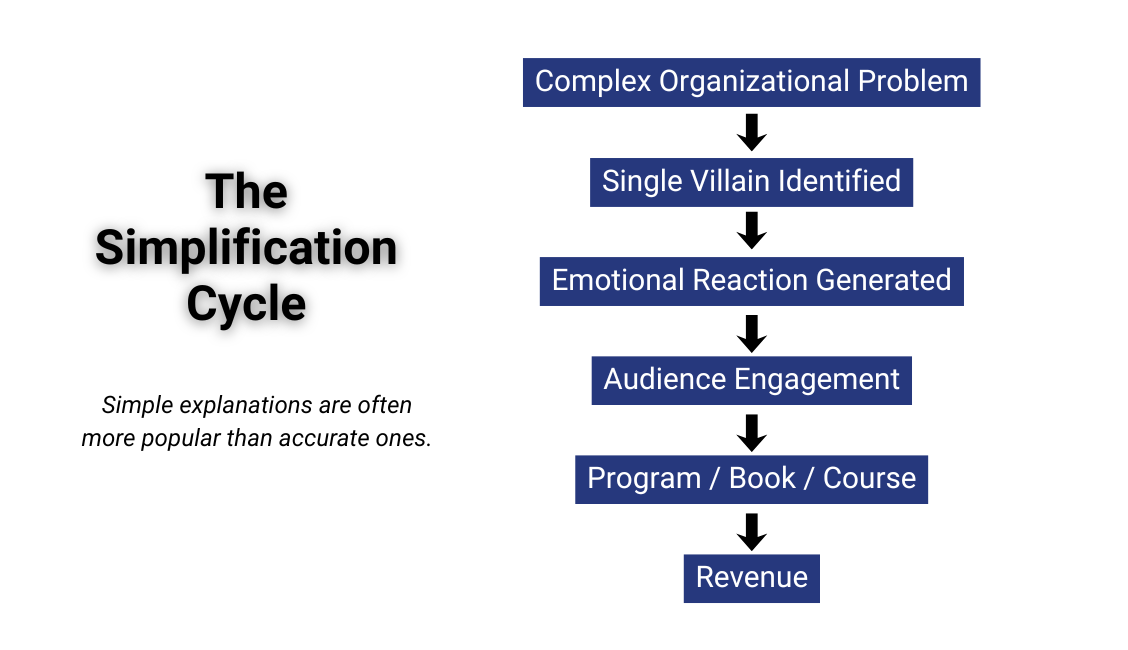
Take a complicated organizational problem. Reduce it to a single villain. Generate an emotional reaction in the audience. Offer a solution, usually in the form of a program, a coaching engagement, a book, or a certification course. Boom, sale.
The approach works because human beings are naturally drawn to simple explanations. We prefer stories with identifiable heroes and clear villains. We are drawn to explanations that remove ambiguity and resolve uncertainty. We find comfort in certainty. We want someone to blame. The psychologists call this fundamental attribution error: the systematic human tendency to over-attribute outcomes to the character and intentions of individuals rather than to the situational and systemic factors that actually drive most behavior in complex organizations.
The organizational consulting industry has learned to exploit this tendency with remarkable precision. Consider the incentive structure. If an influencer or a coach posts that organizational problems are usually caused by a complex interaction of systems, incentives, leadership capability gaps, employee behavior patterns, communication quality, workload design, accountability mechanism failures, and organizational culture dynamics, the audience disengages within the first paragraph. If the same person posts that employees quit because of toxic leaders, engagement spikes. Comments accumulate. The post circulates.
"Popularity and accuracy are not the same thing. They never have been. In organizational diagnosis, they are often opposites."
The problem is exactly what that observation implies: popularity and accuracy are not the same thing. They never have been. In organizational diagnosis, they are often opposites. And in a professional advisory ecosystem increasingly driven by social media metrics, that difference matters enormously to the organizations that receive the advice being amplified.
The coaching industry, by the most recent International Coaching Federation estimates, generated approximately $4.65 billion in revenue in 2022, a 60% increase from the $2.85 billion it generated in 2019. It slowed some in growth in 2026 expected to be $5.3 billion and is projected to approach $8.0 billion by 2030. That is an extraordinary growth rate for any professional services sector. The question that the growth rate invites is this: what is driving the demand?
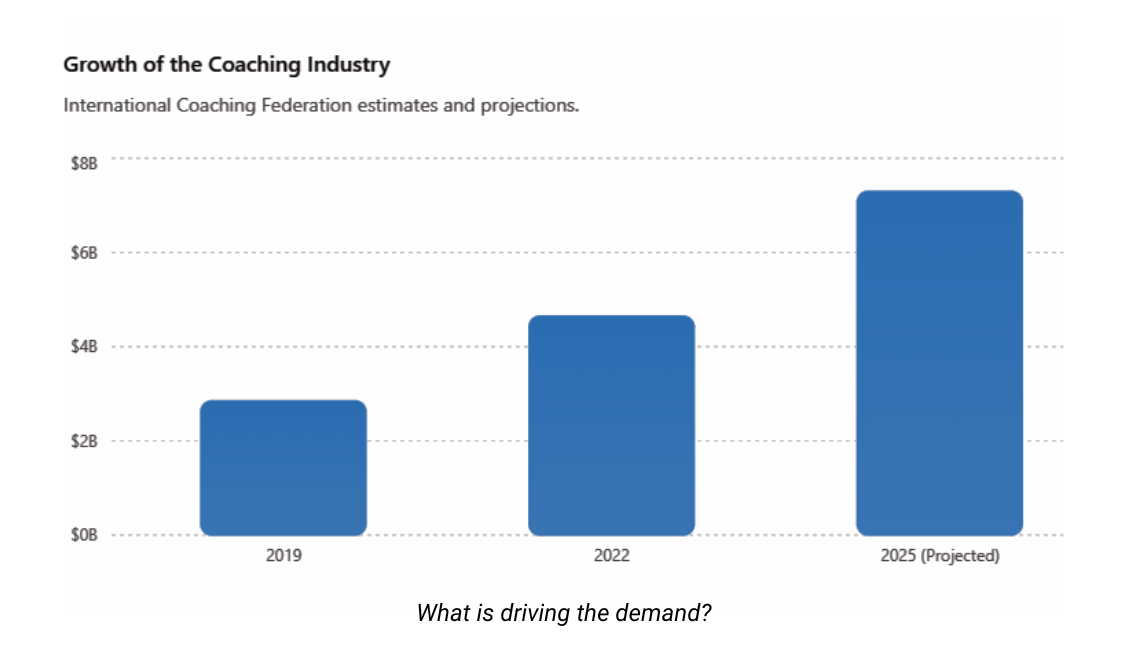
The honest answer, in a significant portion of that market, is fear. Specifically, the fear of being in, managing, leading, or being perceived as responsible for something toxic. A separate topic is FOMO. Fear of missing out on all things ‘leadership,’ but that’s for a different chapter. Courses, books, workshops, certification programs, and podcast series have been constructed on the premise that toxic leadership and toxic workplaces are epidemics. The antidote, conveniently, is available for purchase. Remember, 81% are not toxic? Toxic actually is not an epidemic.
What distinguishes this from legitimate organizational development work is that the diagnosis is also the marketing hook. When the label generates the anxiety and the program resolves it, the provider has a structural incentive to ensure the label remains maximally threatening. That is not a framework designed to produce accurate organizational diagnosis. It is a framework designed to produce revenue.
One of the most telling indicators of this gap between the popular conversation and rigorous practice is how the academic organizational behavior literature actually talks about these phenomena. Researchers, the people who actually measure and study organizational dysfunction over time with validated instruments, peer-reviewed methods, and scientific standards of evidence, generally avoid the word "toxic" almost entirely. The scholarly literature instead uses terms such as destructive leadership, workplace aggression, workplace incivility, abusive supervision, organizational bullying, psychological safety deficits, and organizational justice violations. Those concepts are measurable. They can be operationally defined. They can be studied longitudinally. They have legal correlates. They connect to specific, addressable interventions. It’s beyond the scope of this chapter, but it is also true that the aforementioned terms from ‘scholarly literature’ may also be problematic. We’ll leave that one for another time.
Toxic, by contrast, is often whatever the speaker needs it to mean in order to make their point and hook emotional charge. That imprecision is not a minor stylistic shortcoming. It is an epistemological problem with real operational consequences for every organization that accepts it as a legitimate basis for decision-making.
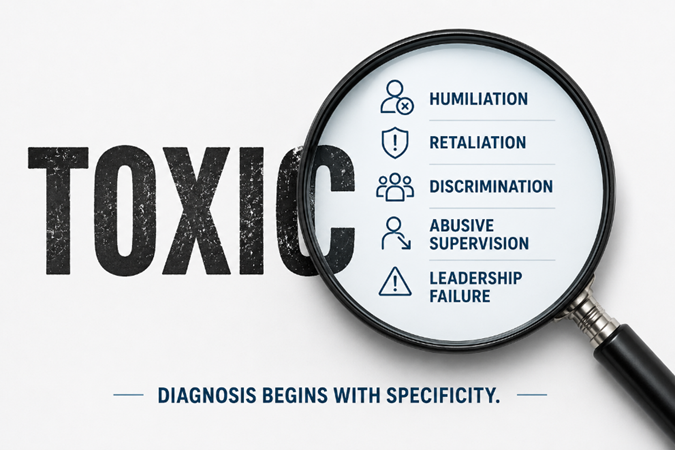
Consider the specificity the word eliminates. If a manager publicly humiliates an employee, there is a precise term for that behavior: humiliation. If a supervisor retaliates against a direct report for raising a legitimate concern, there is a precise term: retaliation. If someone engages in discriminatory conduct on the basis of protected class, there is a term with a full legal framework surrounding it: discrimination. If a leader consistently undermines employees and organizational goals through self-serving or destructive conduct, organizational science offers a rich body of research on destructive leadership that describes exactly what is occurring, how to measure it, and what remedies are available. When we replace all of those specific, actionable descriptions with the word "toxic," we lose the information we need to actually solve the problem.
III. What the Research Actually Says: What Typical LinkedIn Posts Consistently Leave Out
One of the most instructive contrasts I encountered while developing this argument is how different the actual academic research literature is from the dominant popular narrative.
Spend a month consuming LinkedIn posts, leadership blogs, conference promotions, and coaching advertisements, and you will likely conclude that managers and executives are responsible for nearly every significant organizational problem. Employees appear primarily as victims of the system. Leaders appear primarily as perpetrators of dysfunction. Organizational harm appears to flow exclusively in one direction, downward through the hierarchy, from the powerful to the powerless.
The actual research paints a considerably more complicated picture. That complexity is not incidental. It is the single most important reason why the word "toxic," with its implication of a single source contaminating everything downstream, is the wrong frame for the overwhelming majority of organizational problems.
Researchers certainly find credible evidence that destructive leadership harms organizations. Meta-analyses examining outcomes across tens of thousands of employees consistently document negative effects on engagement, satisfaction, organizational commitment, creativity, performance quality, and voluntary turnover. No serious scholar disputes those findings, and neither do I. Destructive leadership is a real phenomenon with real consequences, and organizations that tolerate it are paying a measurable cost.
However, more recent longitudinal research has revealed something the popular conversation consistently ignores: negative employee behaviors contribute to destructive leadership patterns over time.
The relationship between leadership behavior and employee outcomes is not purely one-directional. It is reciprocal.
The relationship between leadership behavior and employee outcomes is not purely one-directional. It is reciprocal. A 2024 meta-analysis published in the Journal of Business Ethics, reviewing longitudinal data across multiple industries, found that employees sometimes attribute their own counterproductive behavior to supervisors as a way of protecting their self-image, and that negative employee conduct can itself elicit increasingly negative supervisory responses over time.
Consider carefully what that research means in practice. Employees influence leaders. Leaders influence employees. Coworkers shape the behavior of other coworkers. Teams shape the responses of managers. Organizational systems influence everyone simultaneously. Culture is not the product of a hierarchy; it is the emergent property of an entire system of interactions, incentives, expectations, and behaviors across every level.
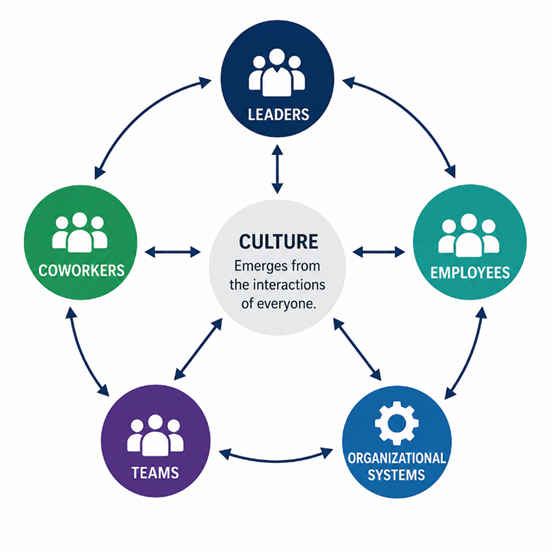
That conclusion should not surprise anyone who has spent meaningful time in a management role. Every experienced executive, every person who has actually run something, knows that some employees elevate the performance of the teams around them while others create continuous conflict. Some people strengthen accountability while others resist it at every opportunity. Some contribute consistently to solutions while others reliably manufacture problems. Some build the trust that effective teams require while others undermine it, sometimes with remarkable creativity. Some are coachable and some refute every suggestion or help for improvement as an unjustified annoyance, even and attack on them personally; and of course, uncalled for.
Yet the contemporary business conversation behaves as though employee behavior is essentially irrelevant to organizational outcomes, as though dysfunction is always and everywhere something that leadership does to employees, never something that emerges from the full system of human interaction within the organization. That framing is not evidence-based management. It is narrative-driven management. And narratives, however emotionally satisfying, are extremely poor substitutes for actual diagnosis.
The SHRM 2022-2023 State of the Workplace Report identified poor organizational communication as one of the most consistently significant drivers of workplace dysfunction across industries.
Communication is, by definition, a bilateral responsibility.

An organization cannot have communication failure that is entirely attributable to one direction of the hierarchy. Employees who do not communicate their needs clearly, who do not raise legitimate concerns through appropriate channels, who do not engage constructively when they receive difficult feedback, and who do not invest in the relational work that effective collaboration genuinely requires are contributing to the dysfunction they are simultaneously experiencing. Acknowledging that reality is not victim-blaming. It is systems thinking. Systems thinking is the only framework that actually solves organizational problems rather than simply relocating them. In addition, there are real constraints on outcomes for employers. Namely, the availability of scarce resources including cash, time and availability of people.
This requires mastery at ‘respectful discarding’ to enhance communication and get teams to really behind resources they in fact have available to them. I've written about this concept in more detail here. It also requires teams to be aligned behind the company’s strategic objective and not continually redefining them. All items employees are expected to commit to when they accept roles in organizations.
The Gallup 2022 State of the Global Workplace Report found that only 32% of U.S. employees were actively engaged in their work. That figure has been widely cited as evidence of a leadership crisis. Less frequently noted is what Gallup's own analysis identified as the primary drivers of that disengagement: unclear expectations, lack of development opportunity, insufficient recognition, and the absence of a sense of mission alignment between the individual and the organization. None of those drivers require the word "toxic" to describe. None of them are solved by identifying and removing a single bad actor. All of them are addressed through specific, structural, managerial interventions that are available to any organization willing to do the diagnostic work honestly. And all of them require the employee to make a decision to contribute and work through issues.
IV. What "Toxic" Actually Means: What It No Longer Does
The word comes from the Greek 'toxikon pharmakon', meaning poison applied to arrows. In its original, scientific sense, toxicity is a measurable property with a specific definition.
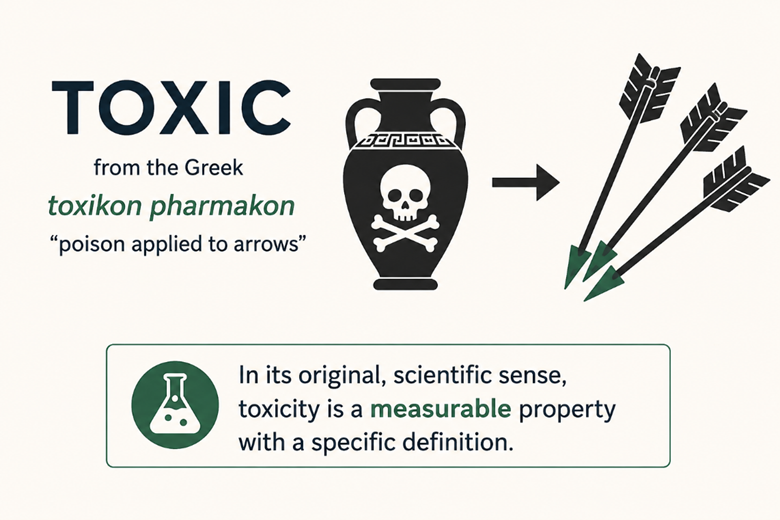
A substance is toxic if it causes demonstrable harm at a specific dose, through a specific mechanism, to a specific biological system. Toxicologists do not call something toxic because it produced a bad feeling. They call it toxic when controlled measurement establishes that it damages living tissue at a predictable threshold. The concept requires specificity, evidence, and a demonstrable mechanism of harm that is reproducible under observation.
In the organizational context, the word was initially borrowed to describe specific, well-documented behavioral patterns: harassment, systematic bullying, discrimination, and abusive supervision. That organizational research had connected through measurable evidence to employee harm.
When researchers at MIT Sloan Management Review published their landmark analysis of 1.3 million Glassdoor reviews in early 2022, they identified a specific set of five cultural attributes they termed the Toxic Five:
disrespectful behavior,
noninclusive practices,
unethical conduct,
cutthroat internal competition,
-
and abusive behavior.
These five attributes are specific. They are observable. They connect to legal standards and established organizational policy. They can be investigated through documented processes and addressed through targeted interventions. (And, keep in mind, Glassdoor is a non-verified one-sided observational perspective. Its unverified data point. And one bad comment, especially utilizing the word toxic, pulls more unverified potentially emotionally biased observations forward. My humble opinion, and food for thought, Glassdoor is not a credible study population). And note, these ‘five’ likely do not actually cause individual harm. Frustration, anger, etc. are not automatically harmful. The Dysfunctional Five is much more appropriate.
The problem is that the word escaped those guardrails long ago. Clinical psychologist Dr. Robert Chandler of Lighthouse Arabia has observed that "continually labeling people or situations as toxic hampers open-mindedness and the capacity to view a situation from diverse perspectives." Once we apply the label, our brains stop observing and start confirming. Every subsequent interaction with the person or situation we have labeled becomes evidence for the verdict we have already delivered. This is what social psychologists call confirmation bias, and in an organizational context its consequences are deeply corrosive to the possibility of resolution.
Research into the psychological dynamics of labeling, documented extensively in organizational science and developmental psychology, shows that negative labels placed on individuals do not simply describe a problem. Through what researchers call the Golem Effect, they create one. When a team member, a manager, or a leader gets labeled as toxic, supervisory and peer expectations drop, behaviors toward that individual shift to reflect those lowered expectations, and over time the individual's actual performance deteriorates in alignment with the label. The label becomes self-fulfilling. (outlets like Glassdoor can accelerate this even further).
Dr. Chandler articulates the personal dimension of this clearly: "The designation of an individual as 'toxic' possesses the potential to instill feelings of shame and self-deprecation. Over time, such labels have the propensity to become internalized." When the word is applied to a human being in an organizational context, it does not open a path toward accountability and correction. It forecloses it.

There is also a harder truth here that I want to name directly. When the word "toxic" enters a workplace conflict, pay attention to who is applying the label and what that application allows them to claim. The word is almost never deployed by someone who is in the middle of honest self-examination. It is deployed by someone who is angry, who feels genuinely wronged, and who has found a single word that simultaneously positions them as a victim of something dangerous and transfers the entire weight of accountability out of themselves and onto another party. The label is, in that sense, a sophisticated act of attribution management. It is not always conscious. But its effect is consistent: once the toxic label lands, the person who placed it is relieved of the obligation to examine their own contribution to the situation they are describing.
V. Anger, Emotion, and the Fuel That Makes It Worse

None of this is to minimize the reality of the emotions driving the use of this word. Anger is a completely normal human response to situations where we feel we have been treated unfairly, disrespected, dismissed, or deliberately undermined. Harvard Health researchers describe anger as "a normal emotional response to a person or situation you believe has treated you unfairly or has otherwise been hurtful or harmful," a biological response rooted in our fundamental fight-or-flight architecture. Feeling angry is not the problem. Organizations that require people to work closely together under pressure are going to produce conditions that generate anger regularly. That is not toxicity. That is the nature of organizational life. To be angry at times is to be human.
The problem is what happens when that anger gets labeled, amplified, and, critically, commercially incentivized. Research into workplace blame culture, published in the Harvard Business Review, documents that human beings are neurologically predisposed to externalize blame when things go wrong. Our brains register negative experiences with greater intensity and retain them with greater fidelity than positive ones. A single difficult interaction with a supervisor, one harsh comment in a tense meeting, one piece of feedback delivered with insufficient care, one decision that felt arbitrary or unfair, can anchor itself in memory as a defining characteristic of that person and that relationship, even when it is entirely unrepresentative of the broader pattern. The intensity of that memory is not evidence of toxicity. It is evidence of how human memory actually works under emotional load.
When someone arrives at the word "toxic" to name that anchor experience, they have done something quite specific psychologically: they have converted a temporary emotional state, justifiable anger, genuine hurt, real frustration, into a permanent character assessment of another human being. And in the current organizational culture, they have done so with a word that carries enormous social weight, that virtually guarantees the sympathy of any professional audience, and that requires no burden of proof whatsoever. The word does the work of a legal verdict without requiring any of the evidentiary standards a legal verdict demands.
"Emotion is real. Labeling emotion as diagnosis is not. One is human. The other is a professional shortcut that organizations cannot afford."
What organizational research tells us about the role of emotion in workplace conflict is consistent and clear: adding fuel to an emotional fire does not produce resolution. It produces escalation. The more a situation is framed as poisonous, categorically dangerous, and requiring emergency intervention, the more the individual experiencing it feels justified in bypassing the harder, slower, more demanding work of diagnosis, direct conversation, and constructive problem-solving. The coaching industry's amplification of the toxic narrative is, in effect, pouring accelerant on the very fires it claims to be trying to extinguish. That is not organizational development. That is the reverse of it.
I want to say something plainly here, because I think it needs to be said without softening: professionals owe it to themselves, to their organizations, and to the people they work with to hold their emotional reactions to a higher standard than a single charged word. Emotion is real. The experiences that produce it are real. But labeling emotion as diagnosis is not diagnosis. It is a professional shortcut, and it is a shortcut that organizations, particularly small businesses operating without the structural redundancy to absorb the consequences of misdiagnosis, cannot afford to take.
VI. The Social Contagion of a Word
There is a specific term for what I have been watching happen in organizational culture over the past several years, and it is worth naming precisely: social contagion.

The concept is well-established in social and behavioral psychology, and its application to organizational language is increasingly supported by the research literature. When a particular framing of experience achieves cultural dominance, when it appears constantly across media, professional networks, podcasts, coaching materials, and HR training content, it begins to actively shape how people interpret their own experiences, often before those experiences have been adequately examined.
The word "toxic" has achieved exactly that kind of saturation. A 2023 paper in the Journal of Occupational and Organizational Psychology noted directly that the academic field itself is struggling with conceptual challenges created by the word's "ambiguity," the fact that it has become simultaneously too broad to be operationally useful and too culturally loaded to be analytically neutral. The researchers identified that the proliferation of the toxic framing in popular discourse had created what they termed a "conceptual challenge" for serious research: it had become genuinely difficult to study organizational dysfunction rigorously because the available vocabulary had been so thoroughly colonized by emotional connotation.
Consider what this means for the ordinary professional navigating a difficult workplace situation. They are not approaching that situation with a clean analytical slate. They are approaching it after having consumed hundreds or thousands of pieces of content, articles, posts, podcasts, TED talks, and coaching promotions, that have pre-framed virtually every form of workplace difficulty as potential toxicity. The cognitive architecture has been built for them before the situation even occurs. They have been handed a lens, and that lens is the lens of the poisoned environment. When they look through it at their own experience, they reliably see what the lens was designed to show them.
This is not a neutral or benign process. Clinical psychologist Dr. Chandler's observation about the self-fulfilling dynamics of labeling is directly relevant here: "Once we label a work environment as 'toxic,' our minds unconsciously search for more data points supporting that narrative. As the narrative strengthens, this leads us to enter situations, meetings, or events with an already defined outcome in our minds of how that situation will play out, which is highly problematic." A person who has decided their workplace is toxic will find evidence of toxicity in situations that might otherwise be interpreted as normal organizational friction, a difficult conversation that needed to happen, or performance feedback that was hard to hear but professionally legitimate.
The economic architecture of social media accelerates all of this. Content framed around threat, victimhood, and moral clarity generates dramatically higher engagement than content framed around nuance, systemic complexity, and shared accountability. The algorithms reward the former and punish the latter with mathematical indifference to the accuracy of either. A LinkedIn post declaring that your boss is toxic will accumulate engagement that a post examining your own role in a communication breakdown will never approach. That asymmetry shapes what content gets produced, what gets amplified, and what framework professionals unconsciously absorb as the standard for interpreting organizational experience.
The result can be an organizational discourse environment that systematically rewards emotional escalation and systematically penalizes the kind of honest, complex, dual-accountability diagnostic thinking that actually resolves dysfunction. This is a problem for organizations of every size, but it is a particularly acute problem for small businesses like the ones I have worked with and operated myself, where the relational dynamics are intimate, the stakes of interpersonal conflict are immediate, and there is essentially no structural margin for the consequences of sustained, unexamined misdiagnosis. This most often holds as well for small departments in larger organizations.
VII. The Invisible Employee: Accountability's Missing
There is a dimension of this conversation that the coaching industry and the leadership development media almost categorically refuse to address, and I want to name it directly, because its absence from the conversation is itself a form of organizational malpractice: the near-complete disappearance of employee-side accountability from the contemporary discourse on workplace dysfunction.
Scroll through the professional content ecosystem on any given day. Post after post, article after article, podcast after podcast frames organizational dysfunction as something that leadership and management do to employees, not as something that emerges from the full system of relationships, behaviors, expectations, incentives, and structural conditions within an organization. Leadership is the cause. Employees are the affected parties. The possibility that dysfunction is bidirectional, that it involves multiple actors at multiple levels, and that its root causes are frequently structural and systemic rather than personal and character-based is almost entirely absent from the popular narrative.
This matters for a reason that goes beyond fairness. It matters because if we frame organizational dysfunction as fundamentally and primarily a leadership problem, we will design solutions that address only the leadership variable, and we will perpetuate the dysfunction indefinitely by leaving every other contributing factor completely untouched.
The research literature in organizational behavior makes the bidirectional nature of dysfunction clear. The 2024 Journal of Business Ethics meta-analysis referenced earlier established that employees sometimes attribute their own counterproductive behavior to their supervisors, meaning that the narrative of the victimized employee and the destructive leader is sometimes partially or substantially the reverse of what the data actually shows. Employee negative behaviors can elicit supervisory responses that then become the basis for claims of abusive or destructive management, creating a cycle in which both parties are contributing to what ultimately gets labeled, from only one direction, as toxic leadership.
SHRM's research on organizational communication found that 86% of employees cite poor communication as a leading driver of workplace failures. Communication does not fail in one direction. When expectations are unclear, when feedback loops are broken, when concerns go unvoiced and resentments accumulate without expression, every person in that system is contributing to the outcome. Employees who do not advocate clearly for what they need, who do not engage constructively when they receive difficult feedback, who interpret directness as aggression and high standards as abuse, and who often incorrectly assume there are ample resources to solve every problem. Those employees are part of the system that produces the dysfunction they experience. Naming that reality is not unkind. It is accurate. And accuracy is what produces solutions. Work on your organizational communication; this is one obvious item to be added to our organizational ‘to-do’ list.
I am making this argument as a person who has held every position in the organizational hierarchy, from laborer sweeping gutters and building fence lines, to foreman, to COO and CEO, and who knows from direct personal experience that management is hard, frequently imperfect, and often performed by people who received almost no preparation for the complexity it involves. I am not defending poor management. I am not defending poor leadership. I am suggesting all people, regardless of role have a learning curve; that includes managers and leaders. I am insisting on honest accounting. And honest accounting requires that we stop pretending the organizational system has only one meaningful actor.
VIII. Dysfunction Is Real: It Has a Name That Actually Works
Let me be unambiguous about something that should not require clarification but apparently does: I am not arguing that organizational abuse does not exist. It does, and it is serious. I am not minimizing harassment, discrimination, systematic bullying, or abusive supervision. Those phenomena are real, they are documented, and they require clear policy frameworks, genuine accountability, and where appropriate, legal remedy.

What I am arguing is that those phenomena already have precise, legally grounded, operationally actionable names. Harassment. Discrimination. Bullying. Abusive supervision. Retaliation. These terms carry legal weight. They have policy frameworks and investigative procedures built around them. They trigger specific organizational and legal responses. When someone uses them, there is an established standard against which the claim can be evaluated and from that evaluation a specific, appropriate course of action can be determined.
The word "toxic" does none of that. It is a metaphor, not a standard. It describes a feeling, not a behavior. And feelings, however genuine and valid as emotional experiences, are not organizational diagnoses. You cannot write a credible corrective action plan against "toxicity." You cannot conduct a legally defensible investigation based on an allegation of toxic culture without first identifying the specific behaviors that constitute that culture. You cannot build a coaching engagement on the premise that the fundamental problem is a person or environment that is categorically poisonous without first doing the diagnostic work that identifies what specific behaviors are actually occurring, at what frequency, with what organizational enabling factors.

That definition automatically generates productive questions:
What is the standard?
What is the measured gap between the standard and the current state?
What is causing the gap, which specific factors?
Who are the actors involved, and what are their respective contributions to the gap?
What interventions are available?
-
What evidence exists for their effectiveness in comparable situations?
These are engineering questions, and I use that framing with full intention. I spent years as an industrial engineer applying structured problem-solving methodology to complex organizational systems before I moved into executive roles where I applied the same discipline to the human and cultural side of organizational performance.
Dysfunction analysis treats people and organizations with the respect of precision. It assumes that there is a solvable problem, that the solution requires understanding the full system, and that everyone within the system has both a contribution to the current state and a potential role in the improved future state. That is a framework for progress. The word "toxic" is a framework for exit, and it rarely produces the relief it promises, because the underlying dysfunction that generated the experience travels with the people who leave it behind. It delays and confuses effective problem resolution. It creates defensiveness where it shouldn’t be. It can move people to a placed working together becomes potentially impossible, even with resolution.
IX. What Professional Leadership Actually Looks Like
There is a reason the most effective leaders I have worked with, studied, and interviewed throughout my career, from the rank of General and other officers in the U.S. Army, Air Force, Marines, and Navy; to CEOs of complex multi-site operations to owner-operators who built something from nothing, do not reach for the word "toxic" to describe their organizational challenges.

It is not that they lack emotional vocabulary, or that they are unaware of dysfunction when they encounter it. It is that they understand a fundamental principle that the Toxicity Industry seems determined to obscure: a leader's primary professional responsibility includes problem solving, not to name enemies.
Naming someone or something as toxic is, at its core, the identification of an enemy. And while enemy identification can be emotionally satisfying, it is an extraordinarily poor substitute for the diagnostic discipline that produces lasting organizational improvement. The leaders who build organizations that actually work, those that produce sustainable results, retain their best people, and develop genuine organizational capability over time, do not identify enemies. They analyze systems. They develop precise situational awareness. They gather specific behavioral data. They ask not just what is wrong but what precisely is different from the standard they need to meet. They make accountability sustainable over time and with all employees. They maintain the discipline to distinguish between what they feel about a situation and what they actually know about it, and they build their interventions on the latter.
Most importantly, they understand that the vast majority of organizational dysfunction is not moral failure. It is a combination of skill gaps and structural misalignment, unclear expectations communicated with insufficient rigor, accumulated interpersonal friction that has never been addressed directly and honestly, and organizational systems that incentivize the wrong behaviors or fail to reward the right ones. None of those causes require a villain to explain them. None of them are resolved by a label. All of them are addressable through honest diagnosis and disciplined management.
That last cause, accumulated interpersonal friction that has never been directly addressed, is, in my experience, the root of the large majority of what gets called toxic in today's organizations. We have built a professional culture that rewards emotional processing and avoids direct, specific, respectful, courageous confrontation of actual behavioral issues. People who have never developed the skill or the willingness to have a direct professional conversation about a real disagreement tend to do one of two things over time: they accommodate silently and build resentment that eventually produces a dramatic break, or they escalate to the most powerful language available to frame their experience. In our current culture, that language is "toxic."
It is the nuclear option of interpersonal conflict. Like all nuclear options, its use ends the possibility of any negotiated resolution.
X. What Professionals Should Say Instead: A Diagnostic Framework
The natural response to critiquing a dominant vocabulary is to offer something better. Humbly, I offer what this might look like in practice.
The first and most important professional discipline is behavioral specificity. When a colleague, a direct report, or a client describes a situation as toxic, the most useful professional response is a direct question: what specifically are you experiencing, how frequently does it occur, and how does it deviate from the organization's stated expectations or established policy? That question does not dismiss the person's experience. It takes it seriously enough to demand the precision that useful diagnosis requires. The specificity of the answer tells you immediately whether you are dealing with a genuine policy or legal matter, specifically harassment, discrimination, systematic retaliation, or abusive supervision, or with a pattern of organizational dysfunction that requires coaching, structural redesign, communication intervention, or some combination of the three. Asking, ‘What is toxic about …?’ pours fuel on the flame. I strongly recommend you do not use ‘What is toxic about…?’
The second discipline is genuine root cause analysis before any intervention decision. Organizational dysfunction is almost always systemic. It involves multiple contributing factors across multiple levels of the organization. A diagnostic methodology that begins with the premise that the problem is a single toxic individual or a categorically poisoned culture will systematically miss the structural, behavioral, and relational factors that are nearly always present and nearly always relevant. The engineering community calls the premature convergence on a single explanation anchoring, a cognitive bias toward the first plausible cause that presents itself. Professional diagnosis requires the discipline to keep asking "and what else?" until the full picture is genuinely visible.
The third discipline is holding the full system accountable. Every person who has a contribution to the current state of dysfunction, whether that is a leader whose communication style creates unnecessary ambiguity, a manager who avoids accountability conversations until they explode, an employee who withholds relevant information, an employee who regularly cuts corners, or an organizational structure that places incompatible priorities in direct competition, needs to be part of the diagnosis and part of the intervention design. Accountability that applies to only one direction of the hierarchy is not accountability. It is selective prosecution, and selective prosecution does not fix systems.
The fourth discipline, and perhaps the most uncomfortable, is refusing to reward the language of crisis. Every time an organization, a leader, or a coach validates "toxic" as a complete and sufficient description of a complex organizational situation, they reinforce the behavioral pattern of reaching for emotional escalation rather than disciplined inquiry. Organizations that want to build genuine resilience and lasting capability need to establish the cultural expectation that specificity, accountability, and structured problem-solving are the professional standard, not the validation of a label that transfers all accountability to a single party and removes the obligation to examine the full system.
What I am describing is, in essence, precision management. It requires more effort than labeling. It requires more intellectual honesty than assigning blame. It requires the willingness to examine situations in which you yourself may be part of the problem, and the professional maturity to remain committed to the work of diagnosis even when the emotional pull toward the simpler explanation is strong. That is not a comfortable standard. It is, however, an effective one.
XI. A Final Word: From Someone in the Game
I am not writing any of this from a position of comfortable theoretical remove. I am a business owner. My own capital is deployed, my name is on it, and my personal livelihood is directly connected to the performance of the organizations I operate and advise. I have built and run organizations across multiple industries and through genuinely difficult environments, generational transition, recession, market disruption, supply chain failure, and the full range of human organizational challenge, and I have seen first-hand what happens when the vocabulary of victimhood replaces the vocabulary of accountability in an organization's culture.
I have seen it in teams I have managed. I have seen it in organizations I have been retained to consult. And I see it in my own business today, where the social contagion of "toxic" language is as present and as consequential as it is anywhere else. The new reality of turnover with employees for most organizations creates a new seed which can enhance or retard cultural progress. The people in my professional orbit who reach for the word most readily are almost never the people whose contribution and accountability are clearest. That pattern is not a coincidence. The word serves a specific psychological function: it locates the problem entirely outside the self, assigns it a dramatic and socially sympathetic label, and relieves the person using it of the obligation to engage in the harder work of examining their own role in the situation they are describing.
I want to be honest about one more thing. I have a great deal of respect for the difficulty of organizational life. Management is hard. Leadership is harder. Communication across different backgrounds, generations, communication styles, and personal histories is genuinely complex and regularly imperfect. People hurt other’s feelings at work, sometimes carelessly, sometimes deliberately, sometimes without awareness that they are doing it at all. I do not minimize any of that complexity, and I do not minimize the real harm that genuine organizational abuse causes to the people who experience it.
What I am asking, and what I am insisting on as someone who has spent into my fifth decade doing this work in real organizations with real stakes, is that we hold ourselves to the professional standard that the actual difficulty of organizational life demands. That standard requires precision, honesty, and the discipline to call things what they are rather than what they feel like in the heat of an emotional moment. Dysfunction is real. It is present in virtually every organization to some degree, in patterns that vary enormously in their severity, their causes, and their tractability. Yet research also shows ‘most’ of us don’t experience this much, and most not at all (81% of organizations do not claim a toxic problem). That is the true form of serious dysfunction, like harassment for instance. When dysfunction happens, it deserves our full analytical attention. It deserves precise language, structured diagnosis, and accountable intervention from every party involved.
What it does not deserve is a borrowed metaphor from toxicology that turns every instance of organizational friction into a chemical hazard, every imperfect leader into a pollutant, and every complex interpersonal dynamic into an emergency requiring evacuation rather than engagement. Cool your jets. Investigate. Solve. And through it all, communicate.
The word "toxic" is not a diagnosis. It has never been a diagnosis. It is an emotional response looking for a label, and it is time for professionals, all of us, to hold ourselves to a higher standard than that.
Let's get to work on the actual problem.
I have reserved a limited number of no-charge problem-solving sessions for leaders, managers, and professionals who have found themselves reaching for the word "toxic" to describe a situation they are navigating, and who are ready to trade the label for a real diagnosis and an effective plan of action to resolution.
If you are dealing with a person, a team dynamic, a cultural issue, or a leadership challenge that you have been calling toxic, I want to work through it with you using the structured, accountability-based diagnostic framework described in this paper. These are genuine working sessions, not sales conversations. I will come prepared with decades of operational and organizational experience and a bias toward actionable precision.
Reach out directly through TheFitProfessional1 to request one of these sessions. Let's call the situation what it actually is, and then let's fix it.
Professional Bibliography
(All sources below contributed directly to the analysis and arguments in this working paper).
Ayres, Paul T. (2026). "Toxic Is Not a Diagnosis: How the Business World Replaced Rigorous Diagnosis with an Emotional Label: Why That Misdiagnosis Is Costing Organizations More Than They Know." Working Paper, TheFitProfessional1 / Leadership Is Bull$hit (forthcoming). June 2, 2026.
American Psychological Association. (2023). Work in America Survey. APA. https://www.apa.org/pubs/reports/work-in-america/2023-workplace-health-well-being
Chandler, Robert, DClinPsyc. (2023). Quoted in "Is the 'Toxic Workplace' Label Overused?" Fast Company Middle East, November 15, 2023. https://fastcompanyme.com
Gallup. (2022). State of the Global Workplace: 2022 Report. Gallup Press. https://www.gallup.com/workplace/349484/state-of-the-global-workplace.aspx
Gallup. (2023). U.S. Employee Engagement Needs a Rebound in 2023. Gallup. https://www.gallup.com/workplace/468233/employee-engagement-needs-rebound-2023.aspx
Haidt, Jonathan, & Lukianoff, Greg. (2018). The Coddling of the American Mind: How Good Intentions and Bad Ideas Are Setting Up a Generation for Failure. Penguin Press. [Labeling theory and the looping effect.]
Harvard Business Review. (2022). "Blame Culture Is Toxic. Here's How to Stop It." February 9, 2022. https://hbr.org/2022/02/blame-culture-is-toxic-heres-how-to-stop-it
Harvard Health Publishing. (2024). "The Nature of Anger." Harvard Medical School. https://www.health.harvard.edu/healthbeat/the-nature-of-anger
International Coaching Federation. (2023). 2023 ICF Global Coaching Study. ICF. https://coachingfederation.org/research/global-coaching-study
International Coaching Federation (ICF) and PricewaterhouseCoopers (PwC). "2025 ICF Global Coaching Study." International Coaching Federation, September 17, 2025. Executive summary, p. 1 (revenue and practitioner figures). https://coachingfederation.org/resource/2025-icf-global-coaching-study-executive-summary/
Journal of Business Ethics. Li, P., Yin, K., Shi, J., et al. (2024). "Are Bad Leaders Indeed Bad for Employees? A Meta-Analysis of Longitudinal Studies Between Destructive Leadership and Employee Outcomes." Journal of Business Ethics, 191, 399–413. https://doi.org/10.1007/s10551-023-05449-2
Journal of Occupational and Organizational Psychology. British Psychological Society. (2023). Call for Abstracts: "Toxicity in Organizations: New Directions in Conceptualization, Causes, Development, and Interventions." https://bpspsychub.onlinelibrary.wiley.com
McKinsey Health Institute. (2022). "Addressing Employee Burnout: Are You Solving the Right Problem?" McKinsey & Company, May 27, 2022. https://www.mckinsey.com/mhi/our-insights/addressing-employee-burnout-are-you-solving-the-right-problem
MIT Sloan Management Review. Sull, Donald, Sull, Charles, & Zweig, Ben. (2022). "Toxic Culture Is Driving the Great Resignation." MIT Sloan Management Review, January 11, 2022. https://sloanreview.mit.edu/article/toxic-culture-is-driving-the-great-resignation/
MIT Sloan Management Review. Sull, Donald, & Sull, Charles. (2022). "How to Fix a Toxic Culture." MIT Sloan Management Review, September 28, 2022. https://sloanreview.mit.edu/article/how-to-fix-a-toxic-culture/
MIT Sloan Management Review. Brighenti, Caio, et al. (2022). "Why Every Leader Needs to Worry About Toxic Culture." MIT Sloan Management Review, March 16, 2022. https://sloanreview.mit.edu/article/why-every-leader-needs-to-worry-about-toxic-culture/
Oxford Languages. (2018). Oxford Word of the Year 2018: Toxic. Oxford University Press. https://languages.oup.com/word-of-the-year/2018/
Society for Human Resource Management (SHRM). (2022). 2022–2023 State of the Workplace Report. SHRM. https://www.shrm.org
Sociabble. (2025). "15 Workplace Communication Statistics You Need to Know." https://www.sociabble.com/blog/employee-communications/communications-statistics/ [Original research: Gatehouse, State of the Sector, citing 86% of employees attribute workplace failures to poor communication.]
Sutton, Robert I. (2007). The No Asshole Rule: Building a Civilized Workplace and Surviving One That Isn't. Business Plus.
Yao, J., Lim, S., Guo, C., et al. (2022). "Experienced Incivility in the Workplace: A Meta-Analytical Review of Its Construct Validity and Nomological Network." Journal of Applied Psychology, 107(2), 193–220.
Zhou, Luisa. "The Coaching Industry Market Size in 2025-26 (Latest Data)." LuisaZhou.com, updated April 20, 2026 (2030 projection of $8.04 billion derived from ICF CAGR data). https://luisazhou.com/blog/coaching-industry-market-size/
TheFitProfessional1 | Paul T. Ayres | www.thefitprofessional1.com | Working Paper, June 2, 2026